Evelyn Richards
American PsychoEvelyn Richards occupies a central place in Patrick Bateman's intimate life, but her relationship with him is never allowed to become a stable romance. She is his fiancée and long-term partner, yet her pursuit of reassurance collides with his evasiveness, cruelty, and hidden violence. Through Evelyn, the novel turns the language of commitment into another form of pressure and consumption: dinners, clothes, apartments, restaurants, and bodily appearances all become surfaces on which affection is negotiated, displayed, or withheld.
Identity and Social World
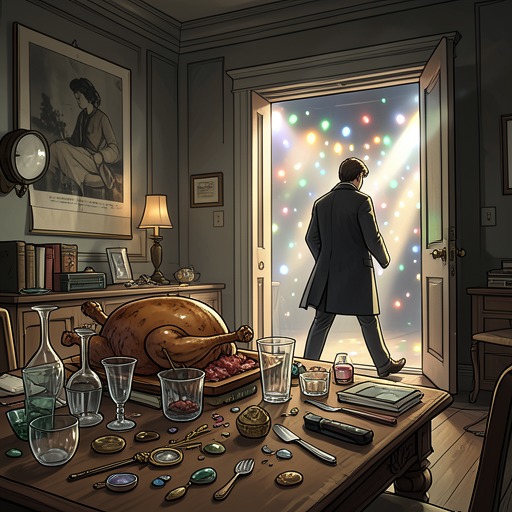
Evelyn is associated with the privileged social environment surrounding Patrick Bateman. Her father bought her a brownstone, and her home functions as a carefully furnished setting for dinners, drinking, and social performance. When Patrick and Timothy Price arrive there, the scene is saturated with status markers: Evelyn serves sorbet in Odeon margarita glasses and brings out an unopened bottle of Glenfiddich, while Patrick and Price occupy her room among an Aubusson carpet, a Ceralene coffee cup, a Jenny B. Goode tapestry pillow, and her Ralph Lauren silk robe. These details do not merely establish wealth; they show a world in which domestic intimacy is organized through branded objects and visible refinement.
Evelyn's social position also places her near the same competitive culture that governs Patrick's male friendships. Patrick's dinner companions compare business cards with the same intensity that they apply to restaurants, clothing, drinks, and professional connections. His own card, taken from an $850 gazelleskin wallet bought at Barney's, provokes a jealous reaction when David Van Patten produces a more elegant card in eggshell with Romalian type. Evelyn is not outside this system. Her home, appearance, and expectations are part of the social theater in which value is repeatedly converted into objects, reservations, and signs of exclusivity.
Relationship with Patrick Bateman
Patrick's relationship with Evelyn is marked by concealment and divided attention from the beginning. During a call about an evening together, he is simultaneously handling other lines involving Courtney Lawrence, a private trainer, a restaurant maître d', and Paul Owen. He chooses Evelyn's call while hoping it is the dry cleaners, then lies to her about whom he is speaking to. He tells Courtney Lawrence that he must take Paul Owen's call and tells Evelyn that he is occupied with his private trainer. The sequence makes intimacy look less like devotion than scheduling: each woman is managed as one appointment among several, and each explanation is selected for convenience.
Evelyn is nevertheless capable of demanding access to the truth. She is staying at the Carlyle because the woman in the brownstone next to hers has been found murdered and decapitated, and the event has left her shaken. Unable to work, she spends the afternoon calming herself with facials at Elizabeth Arden before insisting that Patrick have dinner with her. Her fear gives the meeting an immediate emotional stake, but Patrick meets it with another lie and with the effort to construct a plausible excuse for where he was the previous night. The contrast is stark: Evelyn responds to violence with fear and a search for safety, while Patrick responds to the same atmosphere by protecting his performance.
Their relationship also contains a persistent triangle involving Courtney Lawrence and Luis Carruthers. Courtney leaves Evelyn's gathering early to meet Luis at a company party at Bedlam, while Patrick remains behind with Evelyn and Price. Patrick's jealousy of Luis becomes so extreme that he imagines whether Courtney would like him more if Luis were dead, whether he could comfort her after Luis's death, and whether strangling or hacking Luis apart would improve his own prospects. Evelyn is present in the same mental field as these murderous calculations: Patrick wonders whether marrying Evelyn would force him to buy her Lacroix gowns until their divorce was finalized. Love, marriage, sex, clothing, and murder are thus placed within one comparative economy of possession and advantage.
Fear, Consumption, and Emotional Calculation
Evelyn's relationship with Patrick is shaped by an unstable pursuit of closeness. At her house, Patrick remains even after Courtney, Stash, and Vanden leave, despite Evelyn's hateful look after he tells her that Stash has slipped a piece of sushi into his jacket. Patrick expects that the disclosure may destroy the prospect of sex, yet he stays. Evelyn continues brushing her hair before the mirror, and the scene retains the posture of an ordinary intimate evening while Patrick's observations make the room feel emotionally hostile. Her attention is directed toward her reflection; his attention is directed toward the signs of rejection, sexual access, and social judgment.
The material setting repeatedly turns intimacy into a display of rank. Evelyn's brownstone, expensive glassware, carpet, pillow, robe, and later clothing place her body and surroundings within the same system of conspicuous consumption that defines Patrick's world. Even Patrick's health regimen belongs to this order: Xclusive, the private club four blocks from his apartment on the Upper West Side, costs $5,000 a year and offers remodeled facilities, specialized machines, pools, studios, massages, saunas, tanning booths, and personalized programs. The novel's catalogues of luxury help explain the pressure surrounding Evelyn's demands. Her desire for a secure relationship is expressed inside a culture that treats personal life as something to optimize, display, and acquire.
Patrick's own conduct makes genuine reciprocity impossible. He performs politeness, manages calls, maintains his clothing and body, and gives Evelyn the outward forms of partnership while withholding any dependable emotional presence. His attention can shift from her fear to restaurant logistics, from her body to her wardrobe, and from the possibility of marriage to fantasies of violent disposal. Evelyn seeks a recognizable promise from a person who can imitate the gestures of attachment without possessing their ethical substance.
Breakdown and Separation
The relationship reaches its decisive crisis over dinner. Before the conflict becomes explicit, Patrick's cruelty has already contaminated the meal: Evelyn eats a urinal cake that has been tainted by him, taking only two bites before pushing the plate away and asking the waiter for Life Savers from a Korean deli. Patrick initially treats the spectacle as a source of fascination, but the act produces an anticlimax rather than satisfaction. He realizes that the displeasure it causes Evelyn is also his own, and his endurance for the evening collapses once the melting dessert is removed.
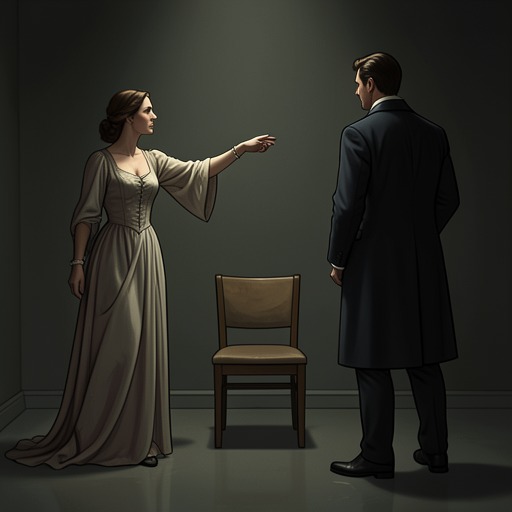
Evelyn then states the demand that gives the scene its emotional name: "I want a firm commitment." The request is direct, but Patrick experiences it as unreasonable and suffocating. He asks the waiter to remove the half-eaten urinal cake, receives water and an Evian bottle, and struggles to formulate a response. He tells her, "I think, Evelyn, that…" before stalling and finally saying, "…that we've lost touch." The statement is less a confession of renewed feeling than an acknowledgment that the relationship's surface rituals no longer conceal its emptiness.
Patrick interprets Evelyn's gaze as something closer to greed than adoration, a perception that exposes his own inability to separate love from possession. Her demand for commitment is therefore not answered by a proposal, explanation, or attempt at repair. Instead, the dinner ends in emotional and bodily disgust, with the failed dessert standing as a grotesque emblem of a relationship that has converted intimacy into endurance, consumption, and control.
Ending and Narrative Significance
After the night of violence and confession that surrounds the novel's closing movement, Patrick reports that he and Evelyn have broken up. When someone asks how she is, he answers, "Well, we broke up." The exchange is strikingly casual in relation to the intensity of her earlier demand. No reconciliation follows, and Evelyn receives no grand gesture or secure romantic ending. The breakup confirms that the novel refuses the usual promise that a demand for honesty or commitment will restore the couple.
Evelyn's significance lies in the way her ordinary romantic expectation exposes the extraordinary moral vacancy of Patrick Bateman. She wants a firm commitment from a man whose social identity is built from interchangeable names, appointments, clothes, restaurants, and professional performances. Patrick can arrange a dinner and appear attentive, but he cannot provide the mutual recognition that would make the arrangement a relationship. His later attempt to confess dozens or hundreds of murders to Harold Carnes, followed by his admission that he is a sick man, does not repair anything; Evelyn remains separated from him, while the surrounding world absorbs or ignores the evidence of his inner collapse.
Her presence therefore connects the novel's private and public structures. The brownstone, the Carlyle, the expensive clothes, the restaurant reservations, and the carefully maintained body all promise order, yet none can protect Evelyn from fear or Patrick from himself. Her failed relationship with Patrick becomes one of the clearest demonstrations of appearance versus reality: the couple possesses the forms of elite romance, but beneath them lie avoidance, jealousy, violence, and a profound inability to establish human contact.